


 Details page
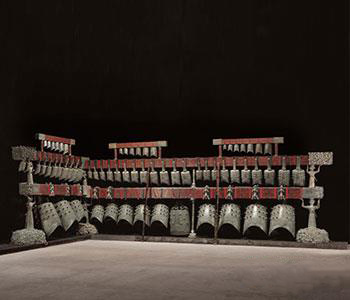
The largest bell has a total height of 152.3 cm and weighs 203.6 kg.
The chime-bells were excavated in 1978 from the Tomb of Marquis Yi of Zeng in Suizhou, Hubei Province, dating back to the early Warring States period. The chime-bells were excavated in 1978 from the Tomb of Marquis Yi of Zeng in Suizhou, Hubei Province, dating back to the early Warring States period. The entire assembly comprises sixty-five individual bells, suspended in eight thematic groups across a three-tiered, L-shaped rack constructed of bronze and timber. The upper tier consists of three groups totaling 19 niuzhong (a bell with semi-circular knob on top); the middle and lower tiers comprise five groups totaling 45 yongzhong (a bell with cylindrical handle on top; hung up in an inclined position), together with one bozhong (a bell with a plane opening; hung vertically by a circular knob) bestowed upon Marquis Yi of Zeng by King Hui of Chu. A total of 3,755 characters are inscribed on the bells, the frame, and the hooks, recording serial numbers, events, pitch notation, and music theory. Each bell possesses the unique dual-pitch capability, striking two distinct notes at an interval of a major or minor third. The entire ensemble boasts an expansive range of five and a half octaves; with a fully chromatic central register of twelve semitones, it is masterfully tuned to perform complex compositions across pentatonic, hexatonic, and heptatonic scales.